

DNRS UK Domain Renewal Scam Email: Don’t Pay Before Checking
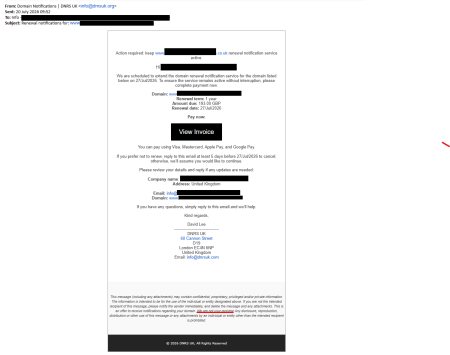
This is not a domain renewal. It is a £193 “notification service”. It is a domain renewal scam.
One of our clients received an email with this subject line:
Renewal notifications for: www.[client-domain].co.uk
The message said “Action required”, gave a “renewal date”, quoted an “amount due” of £193 and presented a large View Invoice button.
It looked like a domain-renewal demand.
It was not.
The sender, describing itself as Domain Notifications | DNRS UK, was not the client’s domain registrar. It was not offering to renew the domain. It was offering to renew a domain renewal notification service — in other words, to charge £193 for sending reminders about a renewal handled by somebody else.
Yes, really.
The truth is in the small print
At the very bottom of the email, in small text, are the words:
“This is an offer to receive notifications regarding your domain. We are not your registrar.”
That sentence changes the meaning of everything above it.
The prominent wording says:
- “Action required”
- “Renewal term: 1 year”
- “Amount due: 193.00 GBP”
- “Renewal date”
- “Pay now”
- “View Invoice”
It also says that if the recipient does not want to renew, they should reply at least five days before the stated date; otherwise, “we’ll assume you would like to continue”.
Continue what, exactly? Our client had no recognised relationship with this sender.
As far as I am concerned, the overall presentation is designed to make a busy business owner or accounts employee think they are looking at a genuine domain-renewal invoice. Only someone who reads to the bottom discovers that the company is not the registrar and the domain itself is not being renewed.
That is why I regard this as a misleading solicitation and a domain renewal scam in the ordinary, everyday sense of the word. Whether it amounts to a breach of advertising, consumer-protection or criminal law is a matter for the relevant authorities. I will be asking them to look at it.
Small print does not automatically make a misleading impression acceptable
Putting the truth in a footer does not necessarily cure a misleading headline.
The Committee of Advertising Practice says marketing communications must not materially mislead. Its guidance also says qualifications should clarify a claim, not contradict it, and should be sufficiently prominent. It specifically warns that qualifications placed at the end of an email, visible only after scrolling, may be insufficient.
That matters here. “We are not your registrar” is not a minor technical detail. It is the central fact a recipient needs in order to understand what is and is not, being sold.
What to do if you receive one of these domain renewal scam emails
Do not click the invoice button and do not pay it simply because it mentions your domain.
Instead:
- Check who actually manages your domain. Look at a previous genuine invoice, sign in to your registrar directly using a saved bookmark, or ask your web provider.
- Check the real renewal date and cost with that registrar.
- Do not use links or contact details in the unexpected email to perform those checks.
- Warn whoever handles invoices in your business. A polished email containing the correct company name and domain can still be misleading.
- Forward suspicious emails to report@phishing.gov.uk, the National Cyber Security Centre’s reporting address.
- If money has been lost, report it through the UK’s official fraud-reporting route and contact the bank immediately.
- Consider complaining to the Advertising Standards Authority about a misleading commercial email. Concerns about unfair trading can also be passed to Trading Standards through the Citizens Advice consumer service.
Our simple rule
If we manage your website or domain and you receive an unexpected renewal demand, send it to us before paying it.
We would much rather spend two minutes checking an email than see a client hand over £193 for a reminder service they neither asked for nor need.
Your genuine registrar renews your domain. A company that says, in the small print, “We are not your registrar” does not.
That should be the first thing the email tells you — not the last.
We build and manage accessible websites for businesses, and we also help our clients make sense of suspicious emails involving their websites and domains.
Sources and reporting links



Would you like to speak with people
who understand inclusive web design?
Whether you are planning a new website, reviewing an existing platform or trying to understand your accessibility obligations, we would love to help.
Please get in touch to discuss your project, accessibility goals or digital challenges.